With the growing demand for creative displays in scenarios such as commercial exhibitions and cultural venues, indoor LED sphere screens have become the top choice for more and more projects, thanks to their advantages of 360° full viewing angle and strong sense of technology. However, many purchasers often fall into confusion when consulting: How much exactly does an indoor LED sphere screen cost per square meter? Especially for the three mainstream models, P2, P2.5 and P3, how to balance the effect and the budget? This article will conduct a comparison from the dimensions of price range, core parameters and applicable scenarios, helping you clarify the differences in cost-effectiveness and avoid procurement misunderstandings.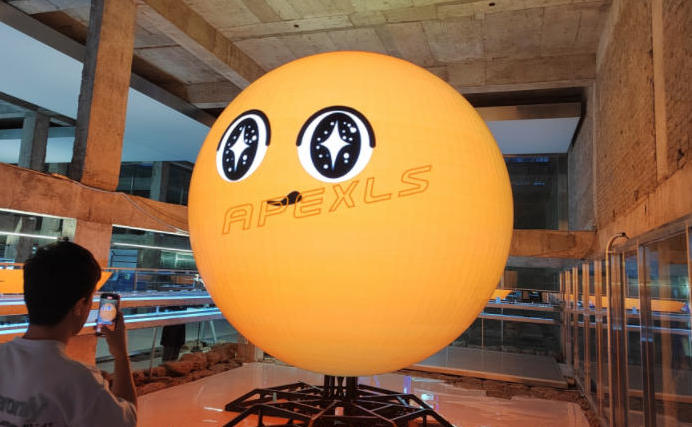
First of all, it should be clear that the price of an indoor LED sphere screen is not fixed, which is affected by various factors such as pixel pitch, lamp bead quality, control system and customization requirements. Based on the 2025 market situation, the core price ranges of the three models P2, P2.5 and P3 are as follows (all are the unit price of the screen body, excluding supporting costs such as installation and transportation): P2 model ranges from $3,000 to $5,000 per square meter, P2.5 model ranges from $2,000 to $3,500 per square meter, and P3 model ranges from $1,500 to $2,500 per square meter. It is not difficult to find that the smaller the pixel pitch (the smaller the P value), the higher the price. This is determined by the manufacturing process of LED sphere screens—smaller pitch means more pixel points per unit area, which puts forward higher requirements for module splicing accuracy and driver chips, and the cost naturally rises accordingly.
To judge the cost-effectiveness of the three models, the core is to combine the matching degree between "display effect" and "usage demand". Let's first compare them from the key parameters:
In terms of pixel density, the P2 model has 250,000 pixels per square meter, the P2.5 has 160,000 pixels per square meter, and the P3 has 111,111 pixels per square meter. Pixel density directly determines the fineness of the picture. The P2 model can present 1080P high-definition image quality, and there will be no graininess even when viewed at close range; the image clarity of P2.5 is second, suitable for medium-distance viewing; the pixel density of P3 is relatively low, more suitable for long-distance viewing scenarios. Taking the actual experience as an example, when viewing at a close distance of about 2 meters, the reduction degree of text and image details of P2 is significantly better than that of P3, while when the viewing distance exceeds 5 meters, the difference in image quality between P2.5 and P3 will be greatly reduced.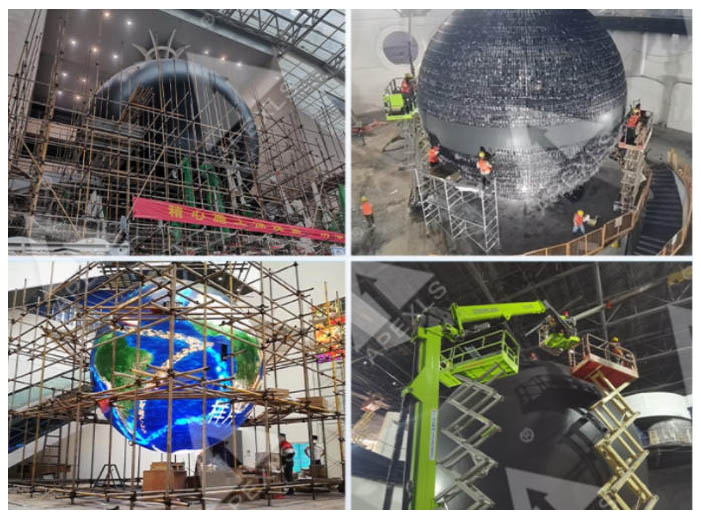
In terms of power consumption and stability, the average power consumption of the three models is not much different, with P2 about 320W per square meter, P2.5 about 300W per square meter, and P3 about 280W per square meter. However, due to the denser pixel points of P2, its heat dissipation demand is higher. If inferior heat dissipation materials are used, the stability may be affected during long-term use. On the contrary, P3 has smaller heat dissipation pressure, has more advantages in stability in long-term continuous operation scenarios, and the later maintenance cost is relatively lower.
Combined with the applicable scenarios, the differences in cost-effectiveness will be more obvious:
The core advantage of the P2 model is high-definition image quality, suitable for scenarios with close viewing distance (2-8 meters) and high requirements for picture precision, such as immersive displays in science and technology museums, product detail presentations in enterprise exhibition halls, and video conference displays in small meeting rooms. In such scenarios, high-definition image quality can directly improve the display effect. Therefore, although P2 has the highest price, it can meet the core needs, and the cost-effectiveness is highlighted instead. It should be noted that the optimal use area of P2 is usually between 6-10 square meters. If the area is too large, the procurement cost will increase significantly. At this time, you can consider whether you really need the full-screen P2 configuration, or adopt a hybrid scheme of "P2 in the core area + P2.5 in the surrounding area" to control costs.
The P2.5 model is currently the "cost-effectiveness king" of indoor LED sphere screens. Its image quality can meet the needs of most indoor scenarios, and the price is about $3,000 per square meter lower than that of P2. It is suitable for medium and large scenarios with a viewing distance of 4-20 meters, such as creative advertising displays in shopping mall atriums, theme presentations in large lecture halls, and general history exhibitions in museums. In such scenarios, the viewing distance is moderate, the image quality of P2.5 is sufficient to ensure the visual effect, and the price advantage can reduce the total project budget, making it the best-selling model in the market at present. Taking an indoor LED sphere screen with a diameter of 3 meters as an example, the total procurement cost of using the P2.5 model is about 15-20% lower than that of P2, but it can achieve similar display effects, and the cost-effectiveness advantage is very prominent.
The core competitiveness of the P3 model is its affordable price, suitable for scenarios with long viewing distance (more than 5 meters) and limited budget, such as stage backgrounds in large banquets, panoramic displays of real estate in sales offices, and atmosphere creation in public areas of shopping malls. In such scenarios, the audience will not observe the screen details at close range, and the image quality of P3 can fully meet the display needs of dynamic images and text information. At the same time, the lower price can greatly reduce the project cost. In addition, the module size of P3 is more flexible. In the customization of large-size sphere screens (with a diameter of more than 5 meters), it can reduce splicing gaps, improve the overall visual integrity, and has small heat dissipation pressure, with lower maintenance costs for long-term use, suitable for large-scale projects with limited budgets.
In addition to the screen price, attention should also be paid to "hidden costs" when purchasing, which are also key factors affecting the overall cost-effectiveness. For example, installation and commissioning fees—due to the much higher splicing accuracy requirements of LED sphere screens than flat screens, the installation and commissioning difficulty of P2 is greater, and the cost is usually 20-30% higher than that of P3; in terms of control system costs, the high-definition P2 requires a higher-level video processor, and the cost is about 15% higher than that of P3; transportation costs are related to the weight of the screen body, and the unit weight of the three models is about 30kg per square meter, with little difference. Therefore, when calculating the total budget, these hidden costs need to be taken into account to avoid budget overruns caused by only focusing on the screen price.
Finally, give selection suggestions based on the 2025 market trends: if the budget is sufficient and you pursue high-definition image quality and close-range viewing effects, prioritize the P2 model; if you need to balance the effect and budget, and the usage scenario is medium-distance viewing, the P2.5 model is the best choice; if the budget is limited and the viewing distance is long, the P3 model can meet the basic display needs at the lowest cost. In addition, it is recommended to choose manufacturers with more than 10 years of production experience when purchasing. Such manufacturers can provide customized solutions, and at the same time ensure product quality and after-sales service, avoiding increasing later maintenance costs due to product quality problems.
In summary, the cost-effectiveness of indoor LED sphere screens cannot only be judged by the price; the key lies in the "matching degree between demand and configuration". The three models P2, P2.5 and P3 each have their own advantages. Only by combining the viewing distance, image quality requirements and budget of their own scenarios can we select the most cost-effective solution. If you are still unsure about the specific model selection, you can provide the venue size, viewing distance and other information to the manufacturer to obtain targeted customized solutions and accurate quotes.