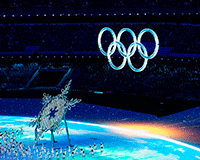

Driven by the dual trends of the digital wave and the upgrading of visual experiences, immersive LED displays have been widely used in various fields such as cultural tourism performances, commercial exhibitions, corporate showrooms, and virtual production, becoming the core carrier connecting the virtual and the real and creating immersive scenes. Different from the "one-way display" of traditional LED displays, immersive LED displays focus on "immersion" and transform the audience from "passive viewing" to "active immersion" through hardware technology, software optimization, and scene integration, achieving multi-dimensional sensory resonance of vision, hearing and even touch. This article will comprehensively analyze the core definition, common types, application advantages, and key requirements for custom matching of immersive LED displays, providing comprehensive references for industry applications and project implementation.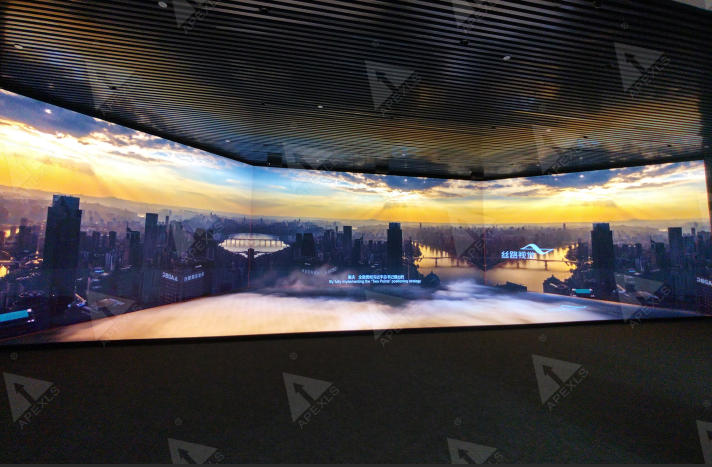
Immersive three-sided LED display screen
I. What is an Immersive LED Display?
An immersive LED display is essentially a high-end display solution integrating high resolution, seamless splicing, intelligent interaction, and creative content design. Its core is to break the "boundary" of traditional screens through technical means, build an all-round, surrounding visual space, and let the audience be in the integration of virtual scenes and real environments, generating an "immersive" sensory experience.
Its core connotation includes three levels: first, at the hardware level, relying on technologies such as micro-pitch LED and flexible LED, it achieves ultra-high resolution, seamless splicing, and wide color gamut image presentation, eliminating visual faults; second, at the scene level, combined with spatial layout, through arc-shaped, spherical, irregular and other shape designs, the screen is deeply integrated with the environment to expand the visual coverage; third, at the experience level, integrating AI, AR/VR, sensors and other technologies to achieve human-screen interaction, transforming the audience from "viewers" to "participants" and enhancing the sense of immersion and participation.
Compared with traditional LED displays, immersive LED displays are not a simple "size expansion" but an "experience upgrade" — they are no longer limited to "displaying information", but create realistic virtual scenes through the in-depth integration of hardware, software and content, making the audience feel as if they are in another world, achieving the ultimate experience of "being in the scene and the scene moving with people".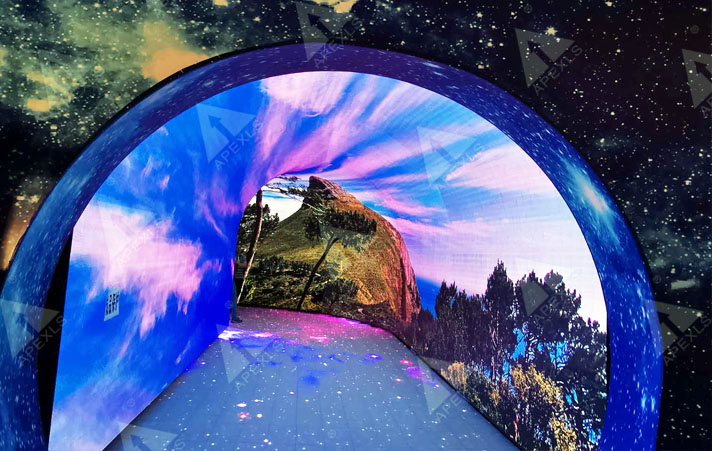
Immersive LED tunnel display screen
II. Common Types of Immersive LED Displays
Combined with application scenarios, shape design and technical characteristics, immersive LED displays are mainly divided into the following 5 types currently. Each type of product adapts to different scene needs, covering the full-scene application from small indoor showrooms to large outdoor cultural tourism projects:
(I) Curved Immersive LED Screens
This is the most common type of immersive LED display, spliced with flexible LED modules. It can be customized with curved radians (common 120°, 180°, 270°) according to scene needs, without splicing gaps. It can wrap the audience's visual range, reduce visual blind spots, and enhance the sense of enclosure. Suitable scenarios include corporate showrooms, cinemas, conference rooms, cultural tourism experience halls, etc. For example, the immersive science popularization exhibition area of a science and technology museum uses a 180° curved screen to simulate scenes such as the universe and the deep sea, allowing the audience to obtain an immersive science popularization experience. Its core advantages are flexible shape, convenient installation, balancing visual effects and spatial adaptability. The pixel pitch can be selected from P0.9-P2.5 according to the viewing distance to meet the clarity needs of different scenes.
(II) Spherical Immersive LED Screens
With a spherical core shape, it is spliced with fully enclosed LED modules, which can achieve 360° dead-angle-free display, creating a "suspended" virtual scene with extremely strong visual impact. It is mainly used in high-end cultural tourism projects, planetariums, large-scale exhibitions and other scenarios. For example, the spherical screen of a planetarium can simulate the starry sky and cosmic galaxies, making the audience feel as if they are in the universe; the spherical screen of a large commercial complex can play 3D creative content, becoming an urban visual landmark. Its technical difficulty lies in the high requirement for module splicing accuracy. Professional geometric correction technology is required to ensure that the image on the spherical surface is free of distortion and uniform in color. At the same time, a dedicated broadcasting control system is needed to achieve 360° content synchronous presentation.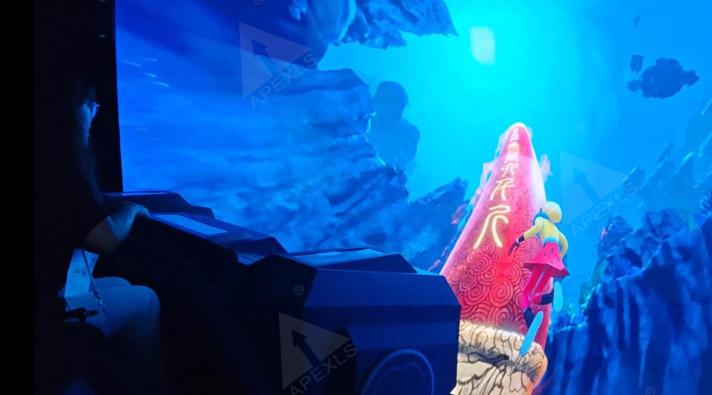
Immersive LED Screen Cinema
(III) Transparent Immersive LED Screens
Adopting transparent LED modules with a transmittance of 70%-90%, it has both "display function" and "transparency characteristics". It can be installed on glass curtain walls, display cabinets, windows and other positions to achieve an immersive effect of "combination of virtual and real" — it does not block the real objects behind, but also can superimpose virtual content to create a three-dimensional immersive experience. Suitable scenarios include luxury store windows, museum cultural relic exhibitions, building curtain walls, shopping mall atriums, etc. For example, in the cultural relic display cabinets of museums, transparent LED screens are used to superimpose 3D restored models and historical background texts of cultural relics, allowing the audience to obtain a richer immersive information experience while viewing the real objects. Its core advantages are not damaging the original spatial layout, realizing the seamless integration of virtual content and real environment, and at the same time having the characteristics of energy saving and light weight, adapting to various installation scenarios.
(IV) Immersive CAVE System (Cave-type LED Screens)
It is a high-end immersive solution, which is composed of multiple LED screens (usually 4-6) spliced into a closed or semi-closed space, covering the front, back, left, right and upper and lower directions of the audience. Combined with surround sound and motion capture technology, it creates a fully enclosed immersive experience, allowing the audience to be completely "immersed" in the virtual scene and obtain a realistic 3D experience without wearing any auxiliary equipment. Suitable scenarios include virtual production, high-end scientific research, military simulation, immersive art exhibitions, etc. For example, in the virtual shooting scene of film and television, a virtual scene is built through the CAVE system, and actors can interact with the virtual environment in real time, reducing shooting costs. Its core characteristics are extremely strong immersion, prominent interactivity, support for multi-user collaboration, real-time motion tracking, and real-time adjustment of visual effects according to user actions. At the same time, it has the advantages of high resolution and high refresh rate to ensure smooth and non-trailing images.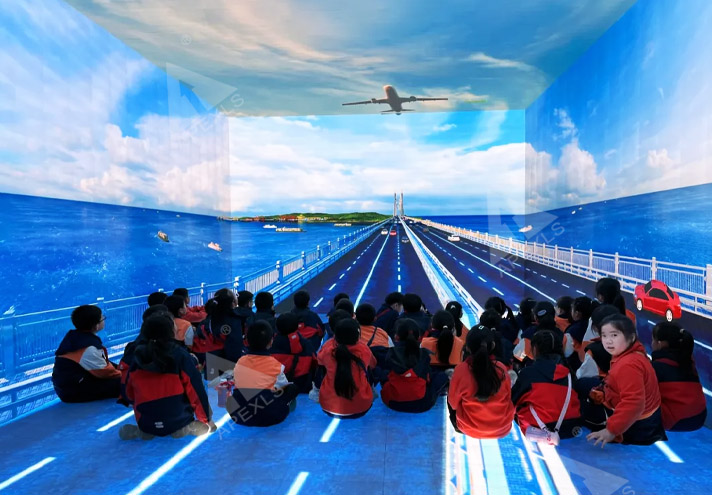
Cave immersive five-sided LED display screen
(V) Irregular-shaped Immersive LED Screens
The shape is customized according to the scene space and creative needs, without a fixed shape. It can be made into wave shape, cylindrical shape, irregular polygon, etc., which is completely adapted to the scene structure, realizing the integration effect of "screen is the scene". It is mainly used in characteristic cultural tourism projects, commercial IP displays, theme parks and other scenarios. For example, the cartoon IP shape screen in theme parks and the art shape screen in commercial squares are deeply bound to the scene theme through irregular design, enhancing the fun and immersion of the scene. Its core advantage is high customization degree, which can meet personalized creative needs. The technical difficulty lies in the accuracy of shape design and module splicing. It is necessary to conduct 3D modeling and structural calculation in advance to ensure that the image is free of distortion and seamless splicing.
III. Application Advantages of Immersive LED Displays
Compared with traditional display carriers such as LED displays and projection equipment, immersive LED displays stand out in various industry applications with their technical characteristics and experience advantages. The core advantages are mainly reflected in the following 4 aspects:
(I) Ultimate Visual Experience and Prominent Immersion
Relying on core parameters such as ultra-high resolution (up to 4K, 8K or even higher), high refresh rate (≥3840Hz), wide color gamut and high contrast, the image is delicate and realistic, full of color, without graininess and trailing, and can restore the details and color levels of real scenes. Combined with seamless splicing and surrounding shape, it completely breaks the boundary of traditional screens, making the audience feel as if they are "in the image". The immersive experience is far superior to traditional display equipment. At the same time, combined with HDR technology, it can realize that the bright color does not overflow and the dark details are not lost, further improving the visual realism and adapting to the experience needs in different light environments.
(II) High Degree of Customization and Strong Adaptability
Whether it is size, shape, pixel pitch, brightness, color, or interactive functions, it can be fully customized according to application scenarios and budget needs. It can not only adapt to small indoor showrooms (such as corporate reception halls), but also meet the needs of large outdoor cultural tourism projects (such as urban landmarks and theme parks); it can be made into conventional arc, spherical, or customized irregular shapes, perfectly adapting to different spatial structures and creative needs, realizing the "in-depth integration of scene and screen", avoiding the "sense of disharmony" of traditional display equipment, and improving the overall texture and sense of technology of the scene.
(III) Strong Stability, Convenient Operation and Maintenance, and Long Service Life
Adopting industrial-grade LED modules, it has the characteristics of waterproof, dustproof, anti-ultraviolet, anti-interference, etc. Outdoor scenes can reach IP65 or above protection level, and indoor scenes can adapt to different temperature and humidity environments. The mean time between failures (MTBF) is ≥100,000 hours, which can meet the 24-hour uninterrupted operation needs, adapting to the needs of long-term operation scenarios such as exhibition halls and cultural tourism projects. At the same time, the modules adopt a modular design. If a single module fails, it can be replaced separately without overall shutdown, with low operation and maintenance cost and high efficiency; some high-end products support remote monitoring and firmware upgrade, further reducing the operation and maintenance workload, extending the service life of the equipment, and achieving long-term stable operation, balancing practicality and economy.
(IV) Strong Interactivity and Wide Application Scenarios
It can integrate AI, AR/VR, gesture recognition, voice control, sensors and other technologies to achieve human-screen interaction and scene linkage, breaking the "passive viewing" mode, allowing the audience to actively participate in it, and improving the sense of experience and memory. For example, switching images through gesture control, adjusting display content through voice commands, or realizing real-time interaction between the audience and virtual scenes through motion capture, making the audience part of the scene. At the same time, it is suitable for many fields such as cultural tourism, commerce, enterprises, scientific research, and film and television, and can realize various functions such as science popularization and education, brand display, entertainment experience, and virtual production. The application scenarios are highly expandable, which can meet the personalized needs of different industries and have great market application potential.
IV. Custom Matching Requirements for Immersive LED Displays
The core value of immersive LED displays lies in "scene adaptation". Custom matching needs to focus on the three cores of "scene demand, experience goal, and budget control", and realize the three-dimensional matching of "hardware, software, and content" combined with site conditions, content needs, and technical parameters, so as to avoid resource waste caused by blindly pursuing high parameters. The specific requirements are as follows:
(I) Preliminary Research: Accurately Matching Scene Needs
First of all, it is necessary to carry out comprehensive site investigation and demand analysis, clarify the scene type (indoor/outdoor), space size, viewing distance, light environment, and core purpose (display, entertainment, science popularization, virtual production, etc.), which is the basis for custom matching. For example, the viewing distance of indoor showrooms is relatively close (2-5 meters), so micro-pitch LED modules with pixel pitch P0.9-P1.5 should be selected to ensure that the image is free of graininess; outdoor cultural tourism scenes have strong light, so modules with brightness above 5000nit and IP65 protection level should be selected, and the module selection and structural design should be optimized in combination with environmental factors such as wind load, temperature and humidity; virtual production scenes need to select modules with high refresh rate (≥3840Hz) and low latency (≤50ms) to ensure real-time interaction and image synchronization.
(II) Hardware Parameter Customization: Adapting to Experience and Scenes
1. Pixel Pitch: Customized according to the viewing distance. The closer the viewing distance, the smaller the pixel pitch. Usually, P0.9-P2.5 for indoor scenes and P2.5-P10 for outdoor scenes, avoiding "blurred images caused by too large pixel pitch" or "increased cost caused by too small pixel pitch";
2. Brightness and Contrast: The brightness of indoor scenes is controlled at 800-1500nit, and that of outdoor scenes is 5000-8000nit, supporting adaptive brightness adjustment to adapt to different light environments, with a contrast ratio of ≥1000000:1 to ensure clear image layers;
3. Refresh Rate and Latency: The refresh rate of conventional scenes is ≥120Hz, and that of virtual production and interactive scenes is ≥3840Hz, with latency ≤50ms, avoiding image trailing and freezing, and ensuring smooth interaction;
4. Shape and Size: Customize arc, spherical, irregular and other shapes according to spatial structure and creative needs. The size should be combined with the site size to ensure comprehensive visual coverage, and at the same time reserve maintenance channels and heat dissipation space to balance practicality and aesthetics;
5. Protection Level: IP65 or above for outdoor scenes, waterproof, dustproof and anti-ultraviolet; IP54 or above for indoor humid scenes (such as swimming pools) to avoid equipment damage and extend service life;
6. Interactive Modules: Configure gesture recognition, voice control, motion capture and other modules according to needs to achieve human-screen interaction, enhance immersion, and ensure sensitive interactive response without latency.
(III) Software and Content Matching: Enhancing Immersive Experience
In terms of software, it is necessary to match a dedicated broadcasting control system, which supports multi-screen synchronous control, image splicing, geometric correction, content switching and other functions, and is compatible with AR/VR, AI and other interactive technologies to realize scene linkage and real-time interaction; for large-scale immersive projects, a "cloud-edge-terminal" three-level intelligent control system can be built to realize remote management, equipment monitoring and content push, improve operational efficiency, ensure stable system operation, and support multi-format content import and scene presets to adapt to different display needs. In terms of content, it is necessary to customize exclusive 3D content and interactive content in combination with the characteristics of immersive scenes, avoiding the use of traditional 2D content (which cannot give play to the advantages of immersion). The content resolution and ratio need to be accurately matched with the screen parameters to ensure that the image is not stretched or distorted. At the same time, combined with the scene theme, create a content effect of "combination of virtual and real" to enhance immersion. For example, cultural tourism scenes can customize regional cultural theme content, and corporate showrooms can customize brand stories and product display content to improve the pertinence and attractiveness of the scene.
(IV) Budget Matching: Balancing Effect and Economy
In the customization process, it is necessary to balance "experience effect" and "budget cost". High-parameter hardware should be preferred for core display areas, and parameters can be appropriately reduced for non-core areas to avoid resource waste; at the same time, modular and scalable products should be preferred to facilitate later upgrades (such as adding interactive functions and expanding size) and reduce later transformation costs; in addition, it is necessary to calculate the full-process costs such as equipment procurement, installation and construction, and later operation and maintenance in advance, optimize the customization plan in combination with the budget, ensure the feasibility of the plan, achieve "maximum cost performance", avoid budget overrun caused by blindly pursuing high-end parameters, and ensure that the core experience is not affected.
V. Conclusion
As the core representative of the new generation of display technology, immersive LED displays are gradually reshaping the visual display and experience mode of various industries with their ultimate immersive experience, high degree of customization, and wide application scenarios. From commercial drainage to cultural tourism empowerment, from science popularization and education to virtual production, their application value is constantly highlighted. The core of its custom matching is "scene adaptation", which needs to realize the three-dimensional integration of hardware, software and content in combination with the site, needs and budget; the core of ensuring experience and stability lies in the in-depth integration of hardware, software and content, which can give full play to the advantages of immersive LED displays and create a high-quality immersive experience.
With the continuous iteration of technology, immersive LED displays will further integrate cutting-edge technologies such as AI, AR/VR and metaverse, realizing more realistic immersive experience, more convenient operation and maintenance management, and wider scene adaptation. In the future, whether it is large-scale cultural tourism projects, high-end commercial complexes, corporate showrooms or scientific research institutions, immersive LED displays will become an important carrier to build core competitiveness, inject new vitality into the development of the industry, and promote visual experience into the "immersive era".