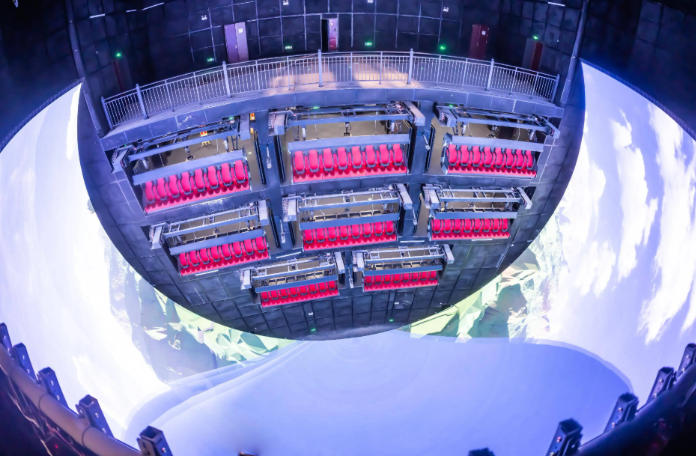
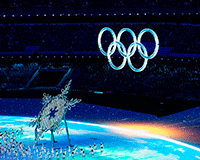
LED dome cinemas and projection dome cinemas are two mainstream technical paths for immersive dome display. Their core differences stem from display principles: the former uses LED self-illuminating modules for imaging, while the latter projects images through multi-projector fusion. They differ significantly in image quality, scene adaptability and return on investment. A comprehensive analysis from four dimensions — principle, characteristics, application and investment — is provided below to support project selection decisions.
I. Core Principle Comparison
1. LED Dome Cinema
- Display Principle: Adopts small-pitch LED curved modules spliced into a complete sphere/hemisphere. Each LED lamp is an independent pixel with active self-illumination, requiring no external light source. Special curved correction algorithms eliminate spherical distortion and realize 360° panoramic seamless display.
- Core Components: Curved LED display modules, curved splicing control system, UHD playback server, sound-transparent/non-transparent structure, surround sound system, dynamic seats (optional).
- Imaging Logic: Electrical signals directly drive LED beads to emit light; screen brightness, color and contrast are determined by LED hardware.
2. Projection Dome Cinema
- Display Principle: Uses multiple high-lumen projectors (laser/xenon) with fisheye short-focus lenses to project images onto a special spherical screen. Edge blending + geometric correction combines multi-projector images into a complete spherical image with passive reflective imaging.
- Core Components: Multi-channel projectors, fisheye lenses, metal/nano sound-transparent domes, fusion servers, audio systems, dynamic seats (optional).
- Imaging Logic: Light source projection → screen reflection → human eye reception. Visual effects are affected by projection brightness, screen material, ambient light and fusion accuracy.
II. Core Characteristics Comparison
1. Image Quality
| Comparison |
LED Dome Cinema |
Projection Dome Cinema |
| Brightness |
800–4500 nits, resistant to ambient light, clear in bright environments |
3000–30000 lumens, requires dark environment, easy to whiten in bright light |
| Contrast |
10,000:1–1,000,000:1, deep black level, strong layers |
1,000:1–5,000:1, grayish black, loss of dark details |
| Resolution |
Supports 8K+, small pitch (P1.45–P4), clear at close view |
Single-unit 4K–8K, visible blending traces, edge resolution loss |
| Color |
Wide color gamut ≥ NTSC 90%, stable and consistent color |
Gamut ≈ NTSC 70%–85%, easy color deviation and aging |
| Response Speed |
Microsecond level, no ghosting or lag |
Millisecond level, blurring in high-speed motion |
| Splicing |
Seamless module splicing, no blending band or distortion |
Multi-projector fusion, visible bright/dark bands, complex calibration |
2. Installation & Structure
- LED Dome: Modular curved design, flexible customization (5–50m diameter). No complicated civil work; fast installation in ~30 days. Supports sound-transparent structure with speakers behind the screen.
- Projection Dome: Limited by projection distance and lens, size usually ≤30m. Requires projection room/hoisting space; complicated optical and civil design. Screen wrinkles and uneven reflection are common.
3. Environmental Adaptability
- LED Dome: All-scenario compatible — indoor, semi-outdoor, open-air. Not affected by sunlight or lighting. Can be made transparent for both daylight visibility and night display.
- Projection Dome: Darkroom only. Even mild ambient light severely reduces image quality. Cannot be used outdoors.
4. Maintenance & Lifespan
- LED Dome: Lifespan >100,000 hours, no consumables. Single-module failure repairable without shutdown. Low maintenance cost.
- Projection Dome: Laser source ~20,000 hours; xenon lamp only 500–2000 hours. High lamp replacement cost. Requires frequent fusion calibration and high maintenance.
III. Application Scenario Comparison
1. LED Dome Cinema (High-end, Landmark, All-weather)
- Cultural & Tourism Landmarks: Theme parks, scenic spots (30–66m super domes), city landmarks with all-weather operation.
- Commercial Complexes: Shopping malls, science and technology museums, usable day and night without blackout.
- Special Performances: Holographic shows, immersive theaters, flying theaters. High brightness supports stage lighting environments.
- Outdoor & Semi-outdoor: Squares, open-air domes, visible even in daylight.
- High-end Science Popularization: Planetariums, aerospace museums with high resolution and color accuracy.
2. Projection Dome Cinema (Traditional, Darkroom, Budget-friendly)
- Traditional Museums & Planetariums: Popular science viewing in darkrooms with controllable cost.
- Small Flying Themes: Small-scale projects in theme parks (10–15m diameter).
- Temporary / Mobile Domes: Quick events, exhibitions with portable projectors and inflatable screens.
- Indoor Cinemas: Pure darkroom operation relying on blackout systems.
IV. Investment & Cost Comparison
1. Initial Construction Cost
- LED Dome: ¥10,000–16,000/㎡. A 15m-diameter dome costs ~¥7–11 million; 30m ~¥28–45 million.
- Projection Dome: 15m-diameter ~¥2–4 million; 30m ~¥5–8 million, about 1/3–1/2 of LED dome.
2. Operation & Maintenance Cost
- LED Dome: Annual maintenance ≤1% of total investment. Almost no consumables. 10-year maintenance ≈10% of initial cost.
- Projection Dome: Annual maintenance ≥5%. Lamp replacement costs ¥200,000–500,000 per year. 10-year maintenance ≈50%–80% of initial cost.
3. Return on Investment Cycle
- LED Dome: 3–5 years. All-weather operation, higher ticket prices and landmark effect bring strong revenue.
- Projection Dome: 5–8 years. Limited to darkroom, lower ticket price and longer payback period.
V. Summary of Advantages & Disadvantages
LED Dome Cinema
✅ Advantages
- Superior image quality: high brightness, contrast, resolution and color gamut.
- All-weather use: no ambient light limitation, indoor/outdoor compatible.
- Flexible structure: unlimited size, fast modular installation.
- Low maintenance: long lifespan, no consumables, low long-term cost.
- High return: landmark effect, premium pricing, fast ROI.
❌ Disadvantages
- High initial investment, 2–3 times that of projection domes.
- Very small pitch required for ultra-close viewing, increasing cost.
- Large-size domes have higher transportation and installation difficulty.
Projection Dome Cinema
✅ Advantages
- Low upfront cost, suitable for limited budgets.
- Mature technology, low implementation risk.
- Portable for temporary and mobile projects.
- Soft light for long-time viewing in dark environments.
❌ Disadvantages
- Poor image quality: low brightness, weak contrast, dark detail loss.
- Must be darkroom-only, poor scene adaptability.
- High long-term maintenance and lamp replacement cost.
- Size limitation, hard to build large landmarks.
- Visible fusion bands and distortion affect immersion.
VI. Selection Suggestions
- Choose LED Dome: For top image quality, all-weather operation, landmark effect, low long-term cost, budget ≥¥5 million, for tourism, commerce, performances and outdoor projects.
- Choose Projection Dome: For limited budget ≤¥3 million, darkroom-only use, traditional science museums, small flying theaters or temporary events.